
BG’s Joshua Foss an ambassador for Living Building Challenge

lbc

LEED and BREEAM are often viewed as the benchmarks for sustainable building.  This may have rung true several years ago, but these standards can no longer lay these claims.  A new player is in town, the Living Building Challenge, which confidently declares itself the most advanced measure of sustainability in the built environment today.  It truly is ambitious, mandating net-zero energy, closed-loop water, urban agriculture, local and toxin-free material procurement, and embodied energy offsets (amongst many other imperatives) through performance-based metrics.  Originally developed in the United States in 2006 as a philosophy, advocacy tool, and certification program, the Living Building Challenge is effectively provoking the deep conversations required within the building industry and beyond to solve pressing problems rather than shift them.

Very much in a nascent stage, the Challenge has successfully certified 4 buildings at varying scales throughout North America, with many more in occupancy and development stages in various parts of the world.  Several iconic projects are now in the works, including a $60 million 5 story office building in downtown Portland, Oregon. With each project that strives for and obtains certification, a bar is raised that proves our built environment is capable of becoming more. This creates a ripple effect that is felt far and wide, energizing those who are on the front lines of sustainable development.

Beyond Green’s own Joshua Foss is from the US and has been an ambassador for the Challenge the past two years. He has been trained by the Living Building Institute to lead volunteer presentations on their behalf.  These genereally entail an hour long seminar presented for interested groups/organizations/events and are qualified to earn attendees’ 1 LEED continuing education hour.  In addition to presenting on the Living Building Challenge, Foss has also contributed to several projects that have aimed for certification, including a multi-family mixed use development in Minneapolis, Minnesota.

Beyond Green certainly understands and is inspired by the Living Building Challenge, but recognises that it is currently not an all-encompassing vision for sustainable development.  Real sustainability must be developed at scale with a focus on quality placemaking without investing too much emphasis on single structures (although the LBC certainly recognises this and looks to be evolving to better incorporate district and neighbourhood scales).  The value the Challenge does however serve is being an icon for sustainability, for raising awareness and excitement within the field, and for acting as an agent to tranform development processes to be more upstream thinking, collaborative, and transparent (all things that we strive to do here at Beyond Green).

If you are interested in learning more about the Living Building Challenge, please contact Joshua.  He is very keen on engaging dialogues here in the UK about the standard and discussing how it fits into the greater sustainable development conversation (he is at the moment the only trained presenter in the country).  Foss can be reached at joshua@beyondgreen.co.uk


Jonathan Smales joins Norwich housing debate

Norwich

Beyond Green executive chairman Jonathan Smales recently contributed his thoughts to an ongoing discussion regarding housing needs and development strategies in Norwich.  37,000 new homes are planned in and around the city by 2026, with 10,000 of these being allocated within the “growth triangle” to the north-east of the city. Our Broadland project is situated within this growth area, which has become a key focus of debate within the Norwich community.

This past Friday, Chris Hill, a rural affairs correspondent for the Norwich Evening News, wrote a constructive and balanced article on the growth triangle and its various critics and supporters.  Smales was given a fair portion of the article to defend the idea that greenfield developments should not automatically be written off as destructive.  He went on to say:

“The population of the UK is growing rapidly and we are very sympathetic to the notion that the priority must be to build on brownfield sites. But the idea that a boundary of a town or city should never change is a weird notion.

“We would be fossilising the boundaries of all places if we never had any greenfield development.

“In certain situations where you can mend an urban edge and put systems in place which are intrinsically sustainable, then it is not only defensible, it can be a very good thing.

“I am not for a second decrying the environmental campaigns but neither would I want to be in a camp that says we should never build on greenfield land under any circumstances. You cannot tar every project with the same brush.”

Mr Smales said the development would increase public access to open spaces including Beeston Park and Red Hall Farm, as well as providing more trees and natural habitat within the planned open spaces.

For a link to the article in its entirety, please click HERE.


Broadland Workshop & Exhibition Recap

IMG_3028

The Beyond Green team spent much of last week in Norwich engaged in a series of public workshops and exhibitions surrounding developments in our Broadland project.  Since the last public exhibitions held in June, our design team has been busy drafting a masterplan for the site, delving deeper into the spatial geography of the area, running ecological and hydrological studies, and looking into how the development could best integrate within the surrounding infrastructure.

On Wednesday the 5th and Friday the 7th of October, we were joined by key stakeholders from over 35 different organisations for a series of workshops exploring key aspects of the project’s development, such as green infrastructure, water, energy and waste management, components of a successful high street and various delivery strategies.  On Saturday and Sunday, we hosted a public exhibition and were joined by 100+ individuals from the immediate community.  Together, these events provided invaluable feedback for determining the next steps for the project.

To those who made it out for the exhibition and workshops, thank you kindly. Your feedback and insights were very much appreciated. If you didn’t get a chance to join us, you can keep up to speed on the project by looking through the exhibition boards (PDF) that were on display at the events.

In the video below, Beyond Green’s Executive Chairman Jonathan Smales briefly discusses the aim of the workshops and the value they bring to the development process as a whole.


Richard Kendall speaks at Imperial College on water neutrality

SuDS Hammarby water feature

Beyond Green Managing Director Richard Kendall recently spoke at an event hosted by Imperial College in London on 21st September.  The theme of the event was water sensitivity in urban developments, with a panel of experts being represented from DEFRA and ICL academics. Richard was the sole representative from the development industry. Prior to a Q&A session, he talked about Beyond Green Developments aspirations to achieve water neutrality (using the same amount of potable water after development had finished across the area) at their Broadlan project in North Norwich.

The key catalysts for achieving this aim were a rainwater harvesting ring following the site’s natural contours which channel water below ground and through over-ground water features, the use of green water (water that is dyed green and delivered through nonstandard pipes) recycling for flushing loos and irrigating green infrastructure, the introduction of water consumption displays and progressive pricing strategies, and a comprehensive network of SuDS (sustainable drainage systems) based on existing topographical sub-catchments for surface water drainage.  The Environment Agency has been helpful in terms of supporting Beyond Green’s ambition as the planning process evolves.  We hope for continued support as we turn these ambitious ideas into reality.


Public invitation to design workshops in Broadland

IMG_1965

We specialise in projects that redefine how people can live high quality lives with low environmental impacts, so it’s great to be able to work in places where there’s a chance to put important principles into practice on a significant scale. And a key factor in making any project like this a success is making the most of the know-how and expertise of the people who live and work nearby.

In Broadland, Norfolk, we’re working in partnership with a number of landowners to bring forward proposals for a high-quality development on land adjoining the built-up fringe of Sprowston and Old Catton. Our aim for the project is to deliver new homes and jobs in a place that offers the highest quality of life with the lowest carbon footprint in Europe.

In June and July we held a series workshops and exhibitions with local residents and other stakeholders (link to report HERE). Since then we’ve been working with our design team to draw up a series of plans and associated strategies.

On Saturday 8th & Sunday 9th October we’re hosting a weekend of public exhibitions and workshops at Sprowston Parish Council on Recreation Ground Road (map HERE) that bring together the know-how, skills and experience of our design team with the passion and local knowledge of residents and stakeholders to review the designs so far and discuss and help shape our plans going forward.

If you live or work nearby we do hope you’ll be able to join us – and please let anyone you think might be interested know! – more details can be seen HERE.


Beyond Green go to Copenhagen

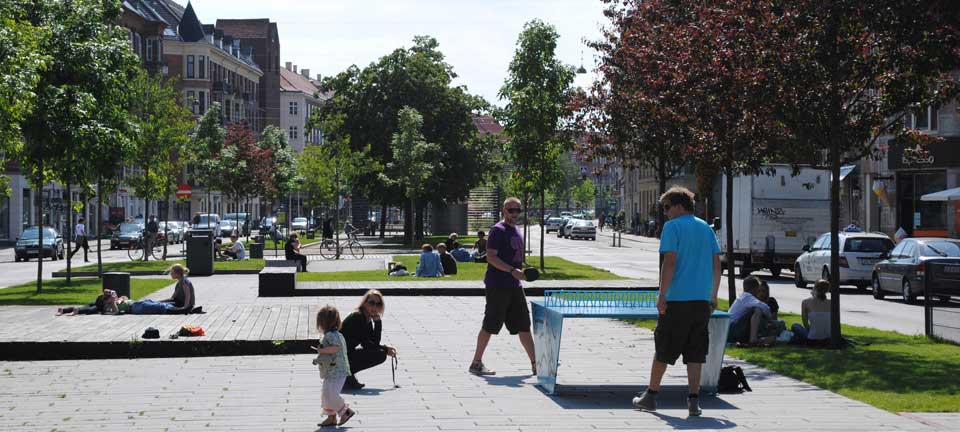
pedestrian friendly Copenhagen waterfront

For the last few months the Beyond Green design team has been busy developing a masterplan for our project in Broadland, an authentically sustainable new community to the north of Norwich.

Last week a small team of us travelled to Copenhagen to see Gehl Architects – leading design practice with a people-first approach to planning and the built environment – who are heading up the work on our public realm strategy at Broadland. We had two days of workshops with their head of design, Oliver Schulze, and architect, Jacob Blak, getting into the detail of the public spaces, parks and streets in advance of a series of design workshops for stakeholders and members of the public in Broadland.

Copenhagen has long been an inspiration to Beyond Green and is well known for its success at challenging the dominance of the car. Over a period of 40 years its taken a series of complementary actions – major investment in cycle lanes, a reduction in city centre car parking, shared surface streets with pedestrian and cycle priority, and investment in public transport – to transform the city to one of the world’s best for cycling with 55% of commuter journeys in central Copenhagen made by bike.

Sadly there wasn’t much time to see the sights of Copenhagen in the short time we were there, but Oliver and Jacob made sure we sampled some traditional Danish food. Make sure you visit Frida’s next time you’re there and try the Pariseboef. Word of warning though – it’s not for the feint hearted (or those on a first date).

Now we’re safely back in the office we’ll be working up the public realm plan and strategies with the Gehl team in time for the Broadland design workshops in October. You can find more information on our work in Broadland including the public realm strategy HERE.


Your chance to complete the Broadland stakeholder questionnaire

Sprowston fete_lo

If you didn’t have the chance to complete the stakeholder questionnaire at one of our recent Broadland public exhibitions you can now fill this out online here.

This survey will help us get a better picture of the local area and the people who live in it. Understanding more about the good and bad points of the place as it is currently will help us to plan a new place that benefits the existing community.The survey is designed to be completed whilst reading the Broadland exhibition


Beyond Green in Broadland survey now online

Following a series of public consultation events we held in Broadland (north of Norwich) in June, we’re encouraging local residents to get involved in discussions via an online survey. Mirroring a successful interactive exhibit at our workshops, the survey looks at eight different aspects of life to explore what people want from a community in the future.

If you’d like to take part in the survey, please click on the link below. The survey will run until September 2011 with the results feeding into the next stage of our design process.

Click here to take part in the survey

Click here to see Norwich Evening News’ article about the survey


Beyond Green survey highlights local desire to live more sustainably in the future

Sprowston Fete June 2011

People in Broadland and Norwich see themselves walking and cycling more, shopping more locally and living greener lifestyles. This is according to a survey conducted this month by Beyond Green about what people want from a new community.

Around 100 people responded to the interactive survey at public exhibitions at Sprowston Fete and St Cuthbert’s Church and professional workshops at Norwich Cathedral’s Hostry. In all, the consultation events were attended by 115 professional stakeholders from 45 organisations, and by over 150 local residents.

Commenting on these results co-founder of Beyond Green, Joanna Yarrow, said that they were “both fascinating and extremely helpful in planning and designing a new place. They give a really good steer about what people think would make a thriving community.

“I’m delighted that there seems to be such an appetite for walking and cycling, driving less, for parks and green spaces and for changes in behaviour to save resources. This is extremely positive and gives us good clues as to what to design for. It also makes me think that maybe the tide’s turning in favour of greener, more sustainable, options –and that people are starting to see that a greener way of life can have the triple advantages of saving much-needed cash, being better for you and saving the planet.”

For further information and a full breakdown of the results, see below. If you would like to be kept informed about our consultation programme, please email broadland@beyondgreen.co.uk asking to be added to our mailing list.

Beyond Green press release 30th June 2011
Beyond Green interactive survey results


Beyond Green disappointed at dismissal of exemplary sustainable community at Pincents Hill

Pincents07_sketch-view

Beyond Green is disappointed by the Secretary of State’s decision to dismiss its appeal for a sustainable new community at Pincents Hill, Reading.

In his report, the Inspector concluded that Beyond Green’s proposals would be benign in their impact on biodiversity, impact on traffic, impact on other local infrastructure and many other areas in which objections had been made by opponents to our proposals. He also acknowledged many of the scheme’s benefits, including the delivery of a wide range of much needed housing, facilities and services and recognised that the sort of development proposed would allow residents to “to gain access to work and leisure facilities without the need for their own car.”

However, the Inspector took the view that there would be “harm to the landscape character of the area” and that “the effect on the wider spatial character of the area would be harmful… because of the effect as seen from important viewpoints” and it is primarily on this basis that the appeal was dismissed.

Beyond Green Chairman, Jonathan Smales, said:

“Obviously we’re deeply disappointed. We have worked hard on this project over some years and we presented a scheme that is compact, green, accessible, affordable, full of character and with a complement of facilities which would both enrich the community and mean that people could walk rather than drive to things they need to meet their everyday needs. We aimed to create a real place. There is no doubt that landscape issues on the fringes of the site are important here but in his report we believe the Inspector made no compelling case as to why they were seen to be paramount, giving succour instead to those of a narrow preservationist mindset.

“Our proposals passed the stringent tests of all the statutory environmental bodies. Moreover Pincents Hill would have been one of the lowest carbon developments in the UK…”

Read more in our press release below.

Beyond Green press statement – June 2011